
Icebergs and spoofing: size you cannot see, and size that was never meant to trade
The order book shows what traders want you to see. Iceberg orders hide most of their size, and spoofed orders show size that is never meant to fill. Here is how each works, how they look in the book and on the tape, and what you can and cannot conclude from them.
What is an iceberg order?
An iceberg order is a large limit order that shows only a small part of its size in the order book. When the shown part trades, the next part appears at the same price, again and again, until the whole order is filled or cancelled. A trader who wants to buy 500 contracts without telling the market might show 20 at a time. Exchanges, including CME Globex, support this as a display quantity on the order; on many platforms it is called an iceberg or a reserve order.
Traders use icebergs so their size does not scare the other side away or invite others to trade in front of them. The hidden size is real: it will trade if price comes to it.
How to spot an iceberg order
You cannot see the hidden size directly, but you can see its footprints when you read the book against the tape:
- Refills. The level shows 20, 20 trade, and 20 appear again at the same price, many times in a row.
- More traded than shown. Far more contracts trade at a price than the book ever displayed there, and size is still resting after.
- Price stalls. Aggressive orders keep hitting the level and price does not get through it.
A busy level that simply re-quotes is not always an iceberg. Market makers cancel and replace all the time. What separates an iceberg is that the level keeps trading through and keeps coming back.
What is spoofing in trading?
Spoofing is placing orders you intend to cancel before they fill, to make the market believe there is more buying or selling interest than there really is. A spoofer might rest a very large bid under the market to draw buyers in, sell to them, then pull the bid. In US futures spoofing is illegal: the Dodd-Frank Act added it to the Commodity Exchange Act, and CME's own rules prohibit disruptive trading practices. Regulators have brought large cases against it.
Pulled size is not proof of spoofing
From the outside, you can see that a large resting order disappeared with almost nothing traded. You cannot see why. Traders cancel orders for honest reasons every second: their plan changed, price moved, a news release is coming, or they were never sure they wanted to trade there. So treat pulled size as information about the book, not as an accusation. The useful question is practical: did that size defend the level, or did it vanish before price arrived?
There is also a timing clue. Size that sits at a level for a long time and is traded against before it leaves behaves differently from size that appears just ahead of price and vanishes just before price arrives. Watching that over time is much easier on a heatmap than on a ladder.
Icebergs and pulled size, side by side
| Iceberg order | Pulled size | |
|---|---|---|
| What the book shows | Less than is really there | More than ended up trading |
| What the tape shows | Repeated trades at one price | Little or no trading at that price |
| What it suggests | Real, patient interest at the level | The level may not hold when tested |
| What it does not prove | Who is behind it or how much is left | Intent: cancelling is normal |
Icebergs, hidden size and pulled size in ORBIT
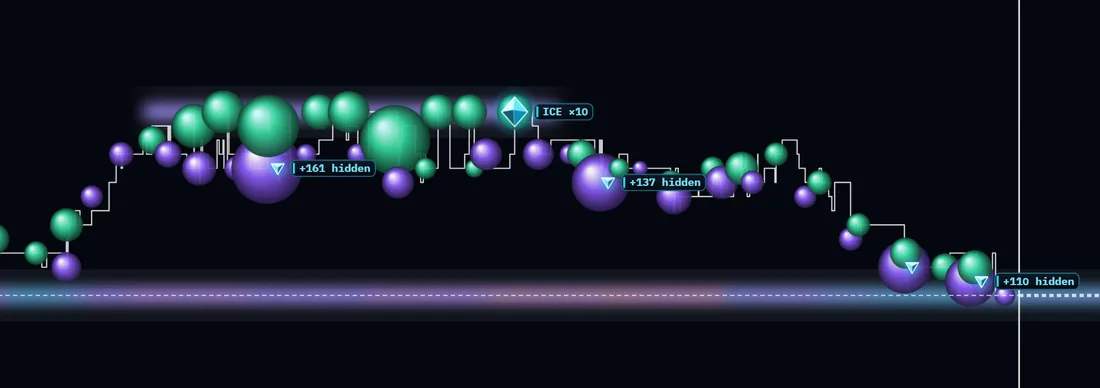
ORBIT's liquidity heatmap reads the recorded order book against the tape near the inside. Its Icebergs and hidden size marker flags a level traded through that comes back again and again, and a price where more traded than the book showed with size still resting after. On the charts, the Book events indicator marks a ring where resting size was traded through, a diamond where a large resting size disappeared with almost nothing traded there (pulled), and a square where a price was traded through and refilled. The heatmap's quotes delta column shows where size was added or pulled across the view.
These markers describe what the book did. They do not name a trader, judge intent, or forecast the next move. All of them need Level 2 depth in your own Rithmic data subscription.
Frequently asked questions
What is an iceberg order?
A large limit order that shows only part of its size in the order book. Each time the shown part trades, more appears at the same price until the order is filled or cancelled.
How do you spot an iceberg order?
Read the book against the tape: a level that trades through and refills again and again, or a price where far more traded than the book ever showed, is the usual footprint.
Is spoofing illegal in futures?
Yes. In the US the Dodd-Frank Act made spoofing a violation of the Commodity Exchange Act, and exchange rules prohibit disruptive trading practices.
Is every pulled order spoofing?
No. Traders cancel orders constantly for honest reasons. A pulled order shows what the book did, not why; treat it as information about whether a level may hold.
Can I place iceberg orders myself?
Many futures platforms and brokers offer a display quantity on limit orders. Check what your platform and broker support before relying on it.
This is education, not financial advice or a recommendation to trade. Examples are illustrations, not results; futures trading involves substantial risk of loss and is not suitable for all investors.