
VWAP bands on NQ futures: the high of the day, and the first test of VWAP
VWAP is the session's average price, weighted by volume. This video switches on VWAP and its bands on the HEATMAP and follows one morning on the Nasdaq futures, line by line.
Watch it on the ORBIT YouTube channel → The video goes live on Tuesday, November 17 at 7:00 PM CT.
What VWAP is, and why volume is the weight
VWAP, the volume-weighted average price, counts each minute's typical price in proportion to how much traded in it, counted from the CME open at 5:00 PM Chicago time. Weighting by volume matters at the open: on this session the 8:30 minute alone traded over eighteen thousand contracts, while a quiet overnight minute traded about five hundred.
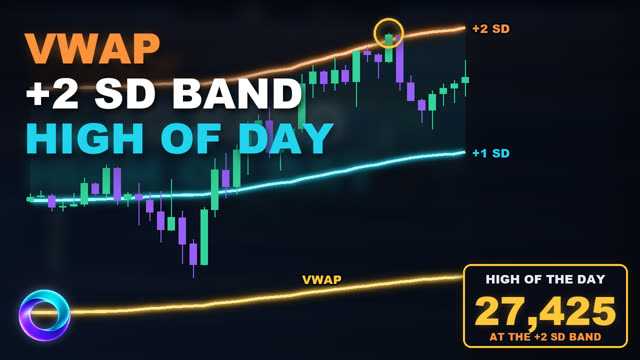
VWAP bands are one, two or three volume-weighted standard deviations either side of VWAP. The HEATMAP draws two each side by default, as orange dashed lines named on chips at the left.
The morning on NQ futures (MNQ, Friday 6 November 2026)
- 8:30 CT, the New York open: price near 27,160 and VWAP near 26,984, about 175 points below. Price traded right around the +1 band.
- 8:35 CT: the dip's low, 27,035.75, stayed about forty-five points above VWAP.
- 8:53 CT: price pushed through the +2 band, near 27,408, to 27,425, the high of the day, about seventeen points above the line. Within half a minute it was back inside the band, about forty points lower.
- 9:35 CT: price traded at VWAP for the first time since before 2 AM. The low was 27,058, about twelve points under the line, and price lifted straight back above it.
The first test of VWAP, on the chart
The desk chart carries the same VWAP and bands. The video draws an example long at that first test: entry 27,075, stop 27,050 under the 9:35 low, target 27,125 at twice the risk. On this recorded session price reached that target at 9:38, a little over two minutes after the entry price traded.
How to use it
Read VWAP as where the session's volume has done its business, and the bands as how far price has stretched from it. A level you already trade that lines up with VWAP or a band is one more reason to pay attention; use them as additional confluence for your own decision. For the opening range itself, see the opening range guide.
Practice it with TIME TRAVEL
Everything in the video was recorded in TIME TRAVEL, a feature of ORBIT: go back to a recorded session, here Friday 6 November 2026 on MNQ, and play it tick by tick from the real recorded tape and order book on a paper (simulated) desk. Hone your skills by going back in time and practicing your setups, as often as you like. Read more in the futures trading simulator guide.
Join the ORBIT Discord
Launch price: sign up before November 30 and keep ORBIT at $79 a month for life, for as long as you stay subscribed. After November 30 the price is $149 a month. Get ORBIT
Love ORBIT? Share it and grow a recurring monthly income with our affiliate program. To express interest, email our founder directly: amlan@tradeonorbit.com
More tutorials like this one are on the ORBIT YouTube channel.
Get ORBIT
The HEATMAP, the desk charts with their indicators, TIME TRAVEL and the paper desk come in one subscription, on your own Rithmic login. Get ORBIT here.
Everything shown was recorded on a paper (simulated) desk in a TIME TRAVEL session of recorded market data; simulated results do not reflect real fills, slippage or commissions. VWAP and its bands describe where trading has already happened; they do not forecast price. This post is education only, not financial advice. Futures trading involves substantial risk of loss and is not suitable for every investor.
Frequently asked questions
What are VWAP bands?
VWAP bands are lines one, two or three volume-weighted standard deviations either side of VWAP. ORBIT's HEATMAP draws two each side by default.
When does ORBIT's VWAP start counting?
From the CME open at 5:00 PM Chicago time, so the whole overnight session counts, weighted by the volume of each minute.
Can I see VWAP on the desk chart too?
Yes. The video ends on the desk chart with the same VWAP and bands drawn on it.